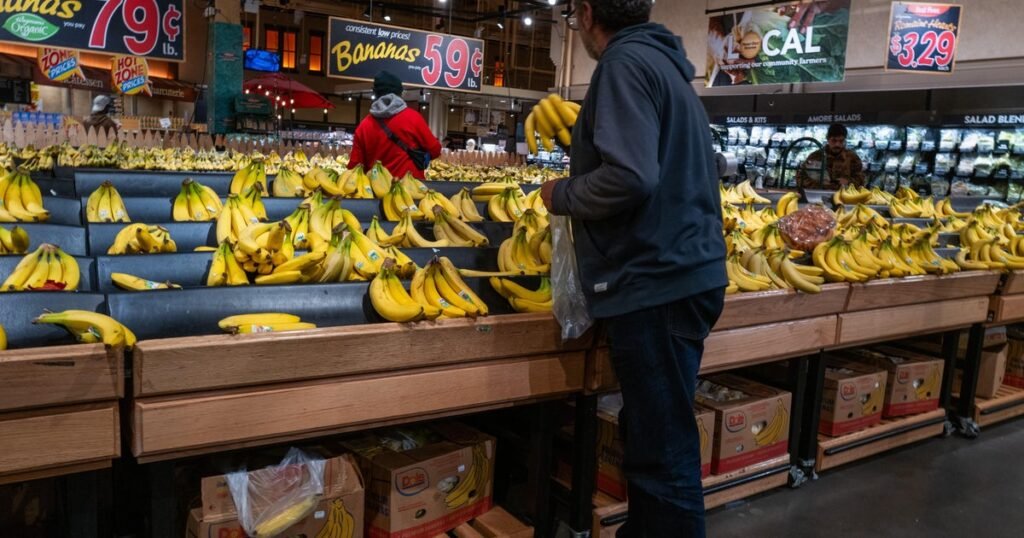

For proof that the price of meals within the U.S. stays arduous to abdomen for a lot of households, look no additional than the worth of bananas, beef and low.
Banana costs had been up 6.9% in September from a 12 months in the past, floor beef has risen 12.9% and roasted espresso has jumped an eye-watering 18.9%, in keeping with the latest Shopper Value Index information for September. And now for the dangerous information.
“One of many questions that I am requested lots is, when are costs coming down? And my reply is easy: by no means,” Phil Lempert, meals trade analyst and editor of SupermarketGuru, informed CBS Information. “One of the best that we are able to hope for is stabilization.”
So what’s behind the surging value of such meals? There are a mixture of elements, starting from the affect of local weather change on crop harvests and U.S. tariffs on imports to the easy legal guidelines of economics.
Beef
As of September, the typical value of a pound of floor beef was $6.30, in keeping with Federal Reserve information — the very best for the reason that Division of Labor began monitoring beef costs within the Eighties and 65% greater than in late 2019, simply earlier than COVID-19 ravaged the economic system.
Over the trailing 12 months by way of September, the price of floor beef has climbed 65 cents per pound, or greater than 11%, whereas the price of a pound of boneless sirloin steak has jumped $2.35, or round 20%, the CBS Information Value Tracker exhibits (see beneath).
The principle cause beef has turn into painfully costly comes all the way down to economics and local weather: As international temperatures rise, shrinking cattle herds are straining the nation’s beef provide whilst demand stays sturdy. As with all different product, costs are likely to rise when demand outstrips provide.
Merely, “The issue is that there is much less cows,” Lempert mentioned.
As of July, there have been 28.7 million beef cows throughout the U.S., the bottom quantity in a long time, USDA information exhibits. Consultants say the decline within the nation’s cattle rely is especially resulting from intensifying droughts in current a long time which have compelled farmers to cut back their herds. Throughout a drought from 2011 to 2015, for instance, farmers and ranchers had been compelled to cut back their herd sizes by as much as 2% a 12 months, the USDA has discovered.
Different elements lifting beef costs embrace greater grain prices and labor provide shortages at slaughterhouses, in keeping with Lempert.
Based on Derrell Peel, a professor within the division of agricultural economics at Oklahoma State College, home beef manufacturing is projected to account for 90% of whole consumption within the U.S. in 2025.
As for beef from Brazil, America’s largest import supply, Peel mentioned tariffs might additionally curb provides. The whole tariff on Brazilian beef imports now sits at 76.4%, in accordance to the American Farm Bureau Federation.
Espresso
The common retail value of 100% floor roast espresso reached a document excessive of $9.14 per pound in September, labor information exhibits. That is effectively over double the worth from December 2019, or shortly earlier than the pandemic, when a pound of floor espresso value simply over $4.
A number of elements are behind this enhance. First, risky climate, together with each heavy rain and droughts in main coffee-producing international locations, equivalent to Brazil and Colombia, are miserable crop yields, Lempert defined. Earlier this month, for instance, espresso costs rose after the Nationwide Oceanic and Atmospheric Administration famous the return of La Niña, a recurring climate sample that influences international temperatures. That raised issues about the potential of drought in Brazil.
Andrew Hultgren, an assistant professor of agricultural and client economics on the College of Illinois, Urbana-Champaign, mentioned international costs for bananas and low will proceed to be delicate to excessive warmth or drought situations, particularly as a result of the merchandise are cultivated in a comparatively small variety of areas all over the world.
“Some of these value sensitivities will appear like inflation to the typical client,” he mentioned.
Lempert additionally mentioned American tariffs on overseas imports are having an affect on home espresso costs. As of 2023 the U.S. imported about 80% its unroasted beans from Latin America, in keeping with the USDA, with Hawaii and Puerto Rico the one U.S. states or territories that produce a lot espresso.
The Trump administration this 12 months has imposed new tariffs on a number of main espresso producers that export to the U.S. That features a 50% levy on Brazil, a ten% tariff on Colombia and a 20% tax on Vietnam. In Brazil, that has led producers to withhold shipments as they negotiate with American roasters over who will soak up the added prices, throttling provides within the U.S., in keeping with funding financial institution UBS.
In a September report, the Worldwide Espresso Group, an intergovernmental membership group for the espresso sector, cited uncertainty round espresso tariffs as one catalyst impacting provide within the U.S. Espresso “can’t be produced within the U.S. on a big sufficient scale to satisfy home demand,” the commerce group famous.
Bananas
Bananas stay cheaper than most fruits, however even this grocery retailer staple is not immune from inflation. The common value of the potassium-rich fruit rose to 67 cents per pound in September — the very best value on document within the U.S. and up 10 cents, or almost 18%, since late 2019, in keeping with information from the Federal Reserve Financial institution of St. Louis.
Amongst shoppers, the problem triggered an uproar final 12 months after Dealer Joe’s introduced it was upping the worth of its bananas for the primary time in over twenty years, from 19 cents every to 23 cents.
As with espresso beans, provide constraints and tariffs have pushed up banana costs, consultants notice. Most bananas offered within the U.S. are imported from Central and South America. Based on the American Farm Bureau Federation, Guatemala equipped 40% of U.S. bananas in 2023, whereas Ecuador and Costa Rica every accounted for 16%.
Tom Stenzel, govt director of the Banana Importers Affiliation, just lately informed CNBC that U.S. tariffs on bananas from Guatemala, Ecuador, Honduras and Costa Rica stay in impact, with levies as excessive as 15%.
A pesky fungal illness generally known as Panama Illness has additionally lowered U.S. banana provides, particularly threatening Cavendish bananas, the most well-liked selection, Lempert famous.
“The banana that we all know and love is getting destroyed by completely different pests,” he mentioned.
