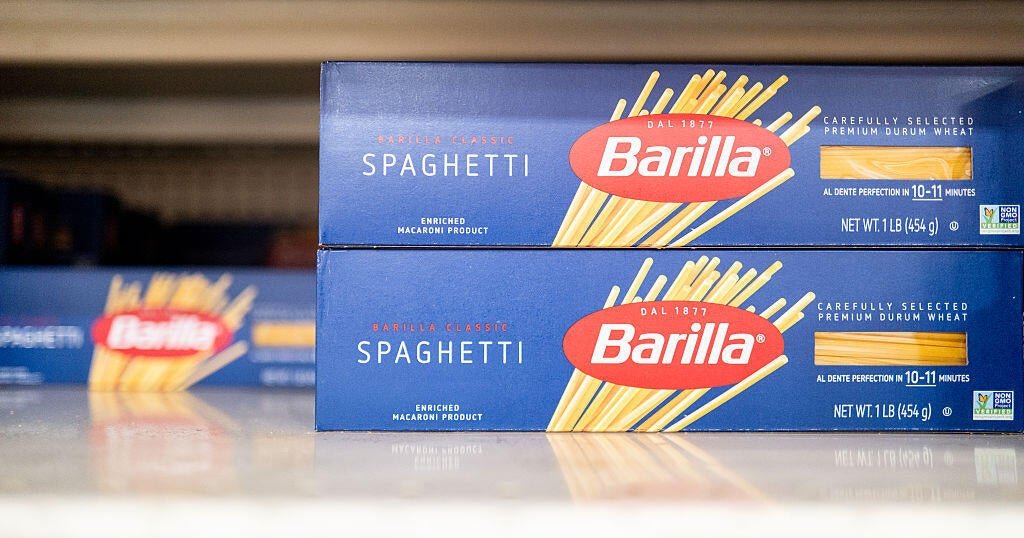

People might quickly be paying extra for his or her favourite Italian pasta manufacturers — and even have hassle discovering imported spaghetti — because the Trump administration eyes a brand new import obligation on 13 of Italy’s largest pasta exporters.
The proposal, revealed by the Commerce Division in September, would add a brand new 92% antidumping obligation after a U.S. authorities probe discovered that some Italian pasta manufacturers, together with La Molisana and Pastificio Lucio Garofalo, had been promoting their merchandise under U.S. market costs. Mixed with the present 15% tariff on European Union imports, the overall duties on Italian-made pasta may rise to 107%.
That might characterize one of many Trump administration’s highest import obligation charges on any product, in accordance with the Wall Avenue Journal, which earlier reported on the pasta dispute.
If the anti-dumping obligation goes into impact, the affect on American shoppers can be substantial, in accordance with Phil Lempert, meals business analyst and editor of SupermarketGuru. Some Italian pasta makers might merely cease exporting their merchandise to the U.S., whereas others may elevate their costs, he added.
“You do not have sufficient home manufacturing to refill these cabinets,” Lempert stated. “So you are going to stroll into the pasta aisle and you are going to see it half empty.”
White Home spokesperson Kush Desai advised CBS Information, “Italian pasta isn’t ‘disappearing.'”
He added that the antidumping obligation is a proposal and that it isn’t but closing. “The pasta makers nonetheless have a number of months to proceed taking part on this overview earlier than this preliminary discovering turns into finalized,” he stated.
But some Italian pasta corporations are making ready to drag out of U.S. shops as quickly as January due to the specter of the brand new antidumping obligation, in accordance with the Wall Avenue Journal.
Which pasta manufacturers could possibly be affected?
The antidumping duties — a kind of federal tariff utilized to imported merchandise offered within the U.S. for lower than their market worth — would affect 13 Italian pasta makers, together with La Molisana and Garofalo, in accordance with a U.S. Division of Commerce publication. The businesses didn’t instantly reply to CBS Information’ request for remark.
- Agritalia
- Aldino
- Antiche Tradizioni Di Gragnano
- Barilla
- Gruppo Milo
- La Molisana
- Pastificio Artigiano Cav. Giuseppe Cocco
- Pastificio Chiavenna
- Pastificio Liguori
- Pastificio Lucio Garofalo
- Pastificio Sgambaro
- Pastificio Tamma
- Rummo
What comes subsequent for Italian pasta
Desai, the White Home spokesperson, advised CBS Information that the businesses in query failed to stick to a number of information requests from the Commerce Division as a part of a long-running probe into Italian pasta makers that has been ongoing because the mid-Nineties.
Desai added that there is no “arduous date” for when the duties would take impact.
The Commerce Division and Worldwide Commerce Administration didn’t instantly reply to CBS Information’ requests for remark.
American pasta makers have lengthy accused their Italian rivals of unfairly undercutting them on value. However the Commerce Division’s proposal might mark a tipping level for Italian exporters that rely closely on the U.S. market.
Final yr, the U.S. imported pasta from Italy valued at $684 million, in accordance with the Observatory of Financial Complexity, which gives international commerce information.
